
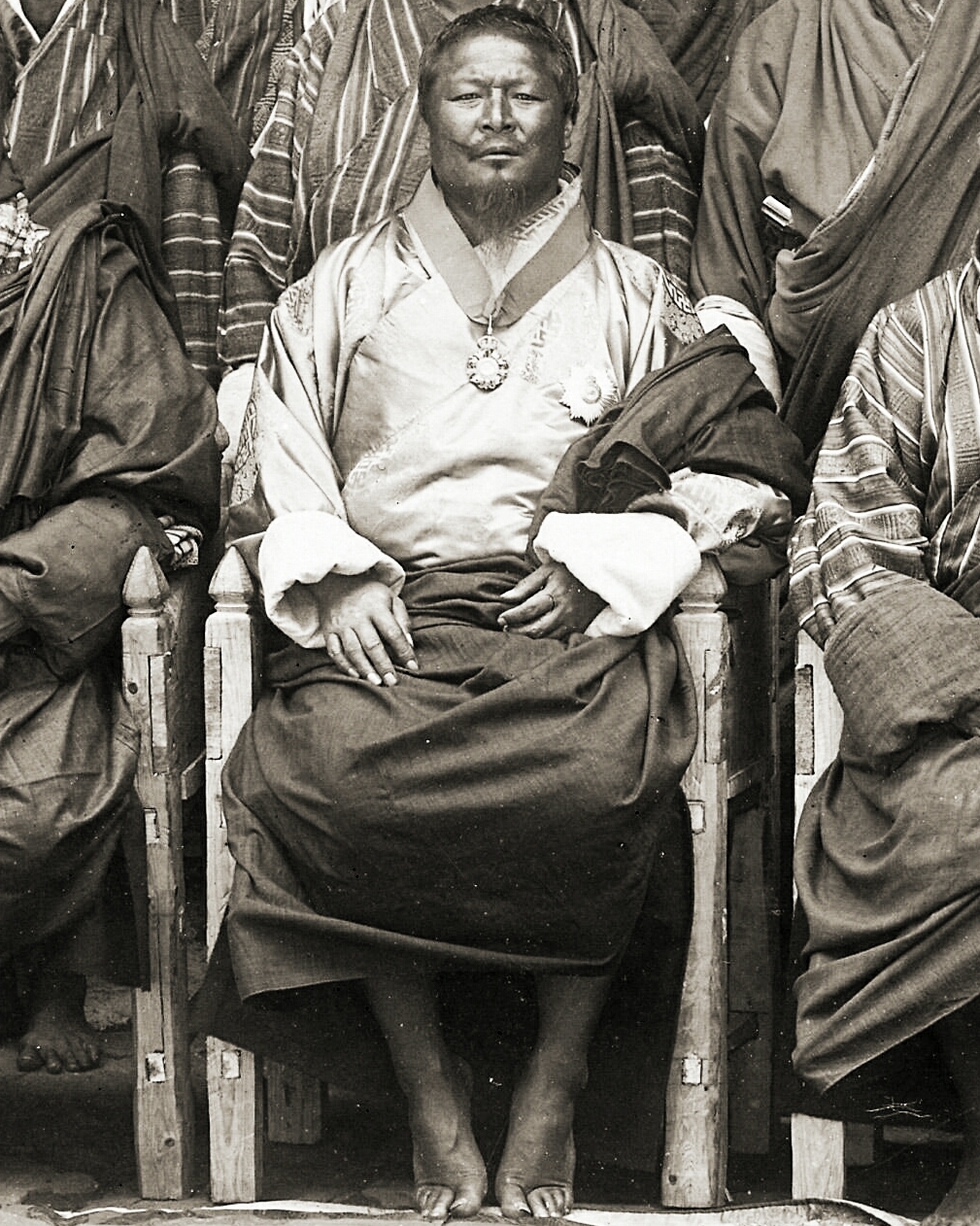
Ugyen Wangchuck
Founder and first hereditary king of Bhutan.

via Wikipedia: Wangchuck dynasty · see source
He united the fledgling country after a period of civil war and established a Buddhist monarchy by unanimous agreement of the people, officials, and clergy.
- field
- Monarchy, statecraft
- nationality
- Bhutanese
- known_for
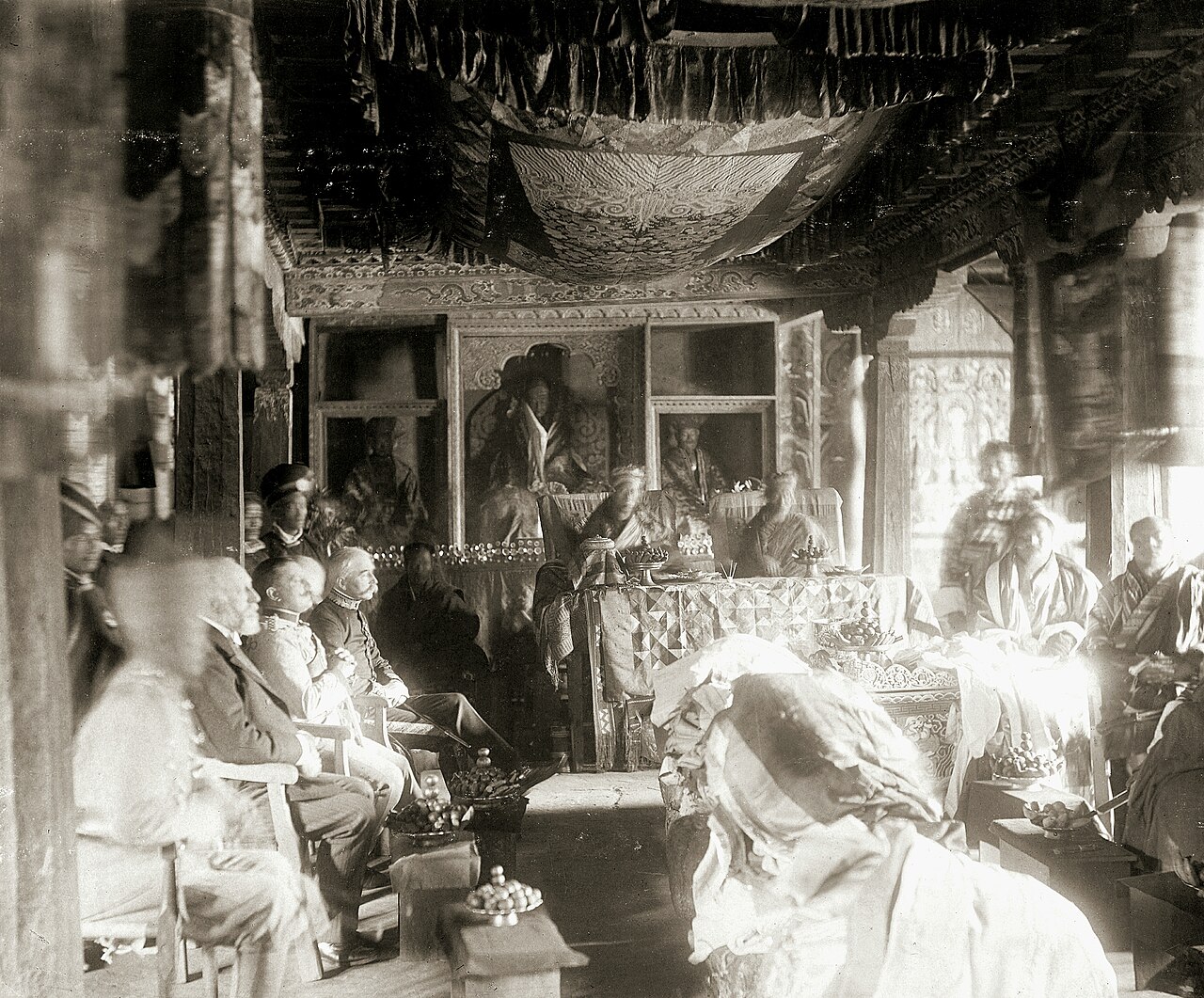
- Founding the hereditary monarchy of Bhutan; unifying the country; mediating the Younghusband Expedition; building Kurjey temple
Verified Timeline
Lore & Background
He was apprenticed in leadership and warfare at a young age.
Reader's Guide
He unified the country after decades of internal strife and established a stable government. He promoted both monastic and Western education, sending monks to study in Tibet and establishing the first Western-style schools in Bhutan. His reign established the Wangchuck dynasty, which continues to rule Bhutan.
Did You Know?
- Ugyen Wangchuck was kidnapped at age 14 by Damchö Rinchen, an enemy of his father.
Lineage and the Fractured World of Pre-Unification Bhutan
The Wangchuck family traces its roots to the Bumthang region in central Bhutan, belonging to the Nyö clan and claiming descent from Pema Lingpa, a revered Nyingmapa saint. This lineage placed them within a local aristocracy that gradually displaced older Tibetan-origin noble houses, particularly those who had aligned with Tibet during its incursions into Bhutanese territory. The clan's most significant political foothold was the hereditary office of Penlop of Trongsa, a position first created in 1616 when Shabdrung Ngawang Namgyal appointed Chogyal Minjur Tenpa as the first Tongsab. After the Shabdrung's death in 1651, Bhutan's theocratic governance fractured into competing temporal and religious authorities, and regional lords—penlops and dzongpons—fought for dominance amid civil wars and foreign invasions from Tibet and the Mongol Empire. The Penlop of Trongsa controlled central Bhutan, while the rival Penlop of Paro held the lucrative western trade routes. This fragmented, conflict-ridden political environment created the conditions from which the Wangchuck ascendancy would eventually emerge.
The Road to Supremacy: Civil Wars and Consolidation
Ugyen Wangchuck's path to dominance was forged through decades of armed conflict. In 1879, his father Jigme Namgyal, then the 48th Druk Desi, appointed the seventeen-year-old Ugyen as the 23rd Penlop of Paro. Following his father's death in 1881, Ugyen entered a bitter feud over the Penlop of Trongsa. In 1882, at just twenty years old, he marched on Bumthang and Trongsa, successfully claiming that office in addition to Paro. The rivalry between the pro-Britain Ugyen and the pro-Tibet, anti-Britain Penlop of Paro culminated in a series of civil wars and rebellions spanning 1882 to 1885. Ugyen ultimately prevailed, and in 1885 he intervened in a dispute between the Dzongpens of Punakha and Thimphu, sacking both factions and seizing Simtokha Dzong. From that point onward, the ancient office of Desi was reduced to a purely ceremonial role, and real authority consolidated under the Penlop of Trongsa. The broader context—British territorial encroachment after the Duar War of 1864–65 and the losses of Cooch Behar and the Assam Duars—had turned armed conflict inward, intensifying the struggle among Bhutanese lords.
Founding the Dynasty: Election as Druk Gyalpo in 1907
After consolidating military and political control over Bhutan's central and western regions, Ugyen Wangchuck, now the 12th Penlop of Trongsa, moved to formalize his authority into a hereditary monarchy. In 1907, an assembly of his subjects elected him as Druk Gyalpo, a title that translates literally as "Dragon King" (or less commonly, "King of the Dragons" or "Thunder Dragon King"). This act of election marked the founding of the Wangchuck dynasty and the end of nearly three centuries of fragmented, theocratic governance that had followed the death of Shabdrung Ngawang Namgyal in 1651. Ugyen's reign, which lasted until his death on 21 August 1926, was shaped by close ties to the British Empire; he was advised by Kazi Ugyen Dorji and accompanied a British expedition to Tibet. The British connection was not incidental—throughout the nineteenth century, the pro-Britain faction led by the Penlop of Trongsa had steadily gained the upper hand against pro-Tibet rivals, and this alignment with British interests helped secure the external recognition that underpinned the new monarchy. The dynasty's first two monarchs would go on to establish formal diplomatic relations with both the British Empire and India.
A Dynasty's Arc: From Unification to Democratization
The Wangchuck dynasty has produced five monarchs, each shaping Bhutan's trajectory in distinct ways. Ugyen Wangchuck (r. 1907–1926) and his son Jigme Wangchuck (r. 1926–1952) focused on consolidating the young state and establishing diplomatic relations with the British Empire and India. The transformation toward modern governance accelerated under the third, fourth, and fifth kings. Jigme Dorji Wangchuck (r. 1952–1972) and Jigme Singye Wangchuck (r. 1972–2006) steered Bhutan along a path of democratization, decentralization, and development. The current monarch, Jigme Khesar Namgyel Wangchuck (r. 2006–present), continues this trajectory. What began as a hereditary military-political office rooted in the Penlop of Trongsa has evolved into a hereditary monarchy that has guided a small Himalayan kingdom from theocratic fragmentation through unification and toward modern democratic governance. The dynasty's longevity—spanning over a century and a half—reflects both the enduring legitimacy of the Wangchuck name and the adaptability of its rulers to Bhutan's shifting political landscape.
Gallery
Frequently Asked Questions
Why is Ugyen Wangchuck considered so important in Bhutanese history?
He is credited with transforming Bhutan from a fractured, warring collection of territories into a cohesive nation-state with a stable Buddhist monarchy. His legacy also includes notable cultural contributions, such as the construction of the Kurjey temple, which remains a landmark of Bhutanese heritage.
More in Monarchs And Rulers Of Asia 1-20
Spotted an error? Know more?
This is a living reference — every entry is fact-audited, and reader corrections feed straight into our audit queue. Suggest an edit · See this site's audit record